

The 5 Cs of credit are character, capacity, capital, collateral, and conditions. They describe the main questions behind a lending decision: How have you handled debt? Can you repay this loan? What funds and property support it? And do the loan terms fit the transaction?

Key Takeaways
- The 5 Cs of credit are character, capacity, capital, collateral, and conditions. They are a lending framework, not a separate approval score.
- Character covers repayment history; capacity covers the ability to repay, including qualifying income and monthly debt.
- Capital includes funds for closing and eligible reserves. Collateral is the property securing the mortgage.
- Conditions include the loan’s purpose and terms. DTI, credit, down-payment, and reserve requirements vary by program and lender.
- Prepare accurate records, compare realistic payments, and address the application’s main constraint. Alternative documentation still requires lender review.
For a mortgage, these questions translate into your credit history, qualifying income, savings, property value, and loan purpose. Understanding them helps you prepare a stronger application, but the five Cs are a framework, not a universal approval formula or a separate credit score. Compare Florida home loan programs as you plan the purchase and financing.
Understanding the 5 Cs of Credit
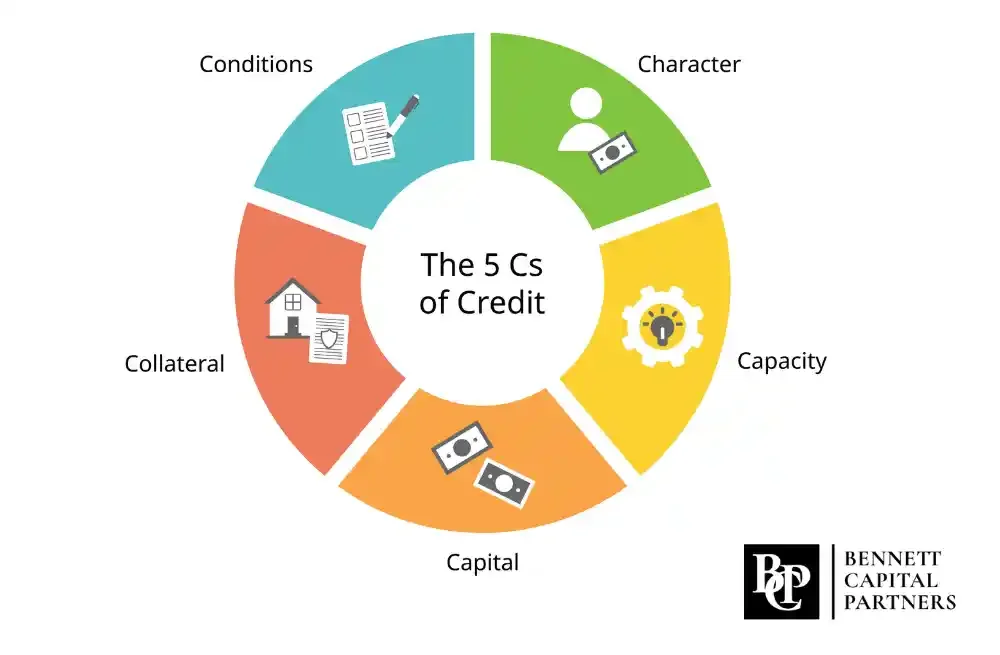
Here is what each C means for a homebuyer, what a lender may review, and how to prepare. The same concepts apply broadly to lending, while the actual requirements depend on your mortgage program and lender.
Character
Character means your record of managing credit and repaying debt. In mortgage underwriting, it is assessed through documented financial behavior, not a judgment of your personal worth. A lender reviews your credit report for payment history, outstanding accounts, and significant credit events.
Your credit score summarizes parts of that history. Most scores range from 300 to 850, but you have more than one score because models and credit bureau data differ. The score in a consumer app may differ from the one used for your mortgage. The FTC explains how credit scores work.
Start by checking your reports for incorrect balances, accounts you do not recognize, and late payments reported in error. Paying bills on time and reducing high revolving balances can support a stronger credit profile; no particular action guarantees a score increase or loan approval.
A past bankruptcy or foreclosure does not tell the whole story. Reporting periods and mortgage waiting periods are different rules. If a lender requests context for a credit event, our letter of explanation guide shows how to present the facts and supporting records without making unsupported claims.
Capacity
Capacity is your ability to make the required payments. Lenders review qualifying income, employment or business history, and existing obligations. Income that reaches your bank account is not automatically the income a lender can use: its stability, documentation, and calculation matter.
A common measure is your debt-to-income ratio (DTI): monthly debt obligations divided by gross qualifying monthly income. For a mortgage application, include the proposed housing payment, with applicable taxes, insurance, mortgage insurance, and association dues, plus other debts the program requires.
Hypothetical example: $2,400 in monthly housing costs plus $800 in other monthly debt equals $3,200. Dividing $3,200 by $8,000 of qualifying gross monthly income gives a 40% DTI. This calculation illustrates the ratio; it does not establish eligibility.
There is no single 43% DTI ceiling for every mortgage. The CFPB explains that limits vary by lender and product. As one program example, Fannie Mae generally permits 36% for manual underwriting, up to 45% with specified credit and reserve qualifications, and up to 50% through Desktop Underwriter. Other requirements still apply, and lenders may be stricter.
Capital
Capital is the money and eligible assets you can contribute to the transaction and retain afterward. Review three separate needs: the down payment, closing costs, and reserves. A large account balance does not mean the entire amount can safely go toward the down payment.
Reserves are eligible funds remaining after closing, often measured in months of housing payments. For example, $18,000 remaining after closing divided by a $3,000 monthly housing payment equals six months of reserves. This is a hypothetical calculation, not a requirement for every borrower; actual reserve rules depend on the program and property.
A larger down payment reduces the amount borrowed, but 20% is not a universal minimum. On a conventional purchase loan, putting down 20% generally avoids borrower-paid private mortgage insurance. That PMI rule should not be applied to FHA mortgage insurance. Compare the full costs of conventional loan options before choosing a down payment.
Keep statements and a clear record of transfers or large deposits. Gift funds may be acceptable under specific program rules and require documentation; our FHA gift funds guide explains that program’s requirements. Preserve money for emergencies and ownership costs instead of exhausting savings solely to make the down payment larger.
Collateral
Collateral is the property securing the mortgage. If the borrower fails to repay, the lender may pursue foreclosure subject to the loan documents and applicable law. The property supports the loan, but its value does not automatically replace the need to qualify.
Lenders assess property value and eligibility through the valuation process required for the loan. An appraisal estimates value; it is not a substitute for a home inspection that evaluates the property’s condition for you.
Loan-to-value ratio (LTV) compares the loan amount with the property value used for underwriting. Hypothetical example: a $400,000 loan against an accepted value of $500,000 has an 80% LTV. Purchase and refinance valuation rules differ, so ask which value applies to your transaction.
There is no universal 80% or 85% maximum LTV across all mortgages. Property type, occupancy, condition, and program rules can affect eligibility. A strong credit score cannot make an ineligible property acceptable under a particular program.
Conditions
Conditions are the purpose and terms of the loan and the circumstances affecting repayment. A primary residence purchase, vacation home, rental investment, and cash-out refinance can have different requirements even for the same borrower.
Interest rates, the loan term, and whether the rate is fixed or adjustable affect the payment and borrowing cost. Compare offers using the same loan amount and assumptions, including points, fees, and any mortgage insurance. Use our mortgage calculator to compare estimates using your own figures.
Your local ownership costs matter too. For a Florida property, budget for the actual insurance quote, property taxes, association dues, and any applicable flood coverage. These costs can materially change a payment estimate even when the advertised mortgage rate stays the same.
Ask how long a quote remains valid, what a rate lock covers, and whether a change in income, debt, or property information would require another review. Avoid treating a market forecast as a guarantee of future rates or approval.
"As a first-time homebuyer, I was overwhelmed by the mortgage process, but Bennett Capital Partners Mortgage Brokers made everything so easy. Philip and his team guided me through every step, explained my loan options clearly, and helped me secure an amazing rate. They truly had my best interests at heart, and I couldn’t be happier with my new home!"
Explore Your Mortgage Options
Discuss your goals, documentation, and financing options with a mortgage broker.
- Loan Options
- Estimated Payments
- Property Review


How the 5 Cs Impact Mortgage Approval
Lenders consider these factors together, but a strength in one area does not automatically cancel a problem in another. The useful question is which requirement limits your application and what documented change would address it.
Evaluating Creditworthiness
Creditworthiness combines repayment history with the ability to handle the proposed debt. A lender may use automated underwriting, manual review, or both, depending on the program. There is no standard consumer “five Cs rating” that replaces those requirements.
Which C matters most? There is no universal ranking. Reliable repayment capacity is essential, but insufficient funds, an ineligible property, or a disqualifying credit event can each prevent a particular loan from proceeding.
Consider two hypothetical applicants with the same credit score. One has manageable monthly debts and documented savings; the other has a larger proposed payment and little cash left after closing. Their financing options can differ even though their scores match.
A preapproval review can identify these differences before you commit to a purchase budget. Ask what remains conditional, including income verification, the property review, and any updated documents needed before closing.
Reducing Credit Risk for Lenders
The five Cs help explain why lenders request information that can seem repetitive. Credit history helps assess repayment behavior, income analysis tests the payment, and assets and collateral help assess financial exposure.
For the borrower, reducing risk means more than qualifying for the largest possible loan. Leave room for maintenance, changes in expenses, and savings goals. A payment that meets an underwriting limit can still be uncomfortable for your household.
Before paying down a debt or increasing your down payment, ask the lender to compare the effect on DTI, cash to close, and remaining reserves. Using the same dollars to solve one issue can create another.
Non-QM Loan Requirements: An Alternative Path
A Non-QM mortgage is a loan outside the Qualified Mortgage category. It can provide a different documentation or underwriting approach, but it is not automatic approval, and “Non-QM” does not mean no review of repayment ability.
The five Cs still help organize the application. A self-employed borrower may have substantial cash flow that is not represented by a simple salary figure. The lender must determine what documentation and income calculation its program accepts.
There is no universal 620 credit score or 50% DTI rule for all Non-QM loans. Credit, down payment, reserves, property eligibility, and documentation vary. Review the Non-QM loan requirements guide alongside the specific lender’s current criteria.
Compare a Non-QM option with available conventional or government-backed financing before choosing. Review the rate, fees, payment structure, and any applicable prepayment penalty, rather than assuming alternative documentation is the least expensive route.
Bennett Capital Partners Mortgage Brokers can help review your circumstances and discuss available Non-QM financing options. Program availability and approval depend on the complete application and lender review.
Obtaining a Mortgage without Traditional Documentation
Alternative documentation means a different way to support the application, not permission to omit material facts. The right approach depends on whether you earn employment income, operate a business, hold substantial assets, or finance an investment property.
Bank statement loans: Some programs evaluate eligible deposits and business expenses to calculate qualifying income. Gross deposits are not automatically usable income. Read our bank statement mortgage guide for the distinction.
Asset-based qualification: Certain programs consider eligible assets under a defined calculation. Access restrictions, asset type, and funds needed for closing can affect the usable amount. Our asset-based mortgage guide explains the approach.
Rental-property financing: Some business-purpose investor loans focus on rental cash flow and debt-service coverage rather than the borrower’s personal DTI. They are not a substitute for a primary-residence mortgage. See the DSCR loan requirements for that separate path.
Expect requests for identification, asset statements, property information, and the records required by the selected program. Do not move funds or leave out liabilities to make a file appear stronger; explain unusual items and provide the requested evidence.
Ask for a written documentation checklist early. Knowing what the underwriter needs helps you compare realistic options and avoid relying on a loan description that does not fit your income or intended property use.
"I've been investing in real estate for years, and finding the right financing partner is crucial. Bennett Capital Partners Mortgage Brokers exceeded my expectations. They helped me secure a DSCR loan quickly and efficiently, allowing me to expand my portfolio without the usual red tape. Their expertise and professionalism set them apart from other brokers I’ve worked with."
Tips to Strengthen Your 5 Cs
Prepare around the weak points in your actual application. These steps help organize the evidence a lender needs while keeping your own budget in view.
Building a Strong Credit History
Check your credit reports before applying and dispute inaccurate information with the reporting company. The FTC links to the authorized free-report service in its credit-score guidance. A report review helps you identify problems; it is not the same as a mortgage credit decision.
Make payments on time and review revolving balances relative to available credit. Avoid opening or closing accounts solely because you expect an immediate score benefit. Ask your mortgage professional how a proposed credit change could affect the application.
Keep making all required payments during underwriting. New debts can change your DTI, and a preapproval may need to be updated when your financial circumstances change. Tell the lender about material changes promptly.
Demonstrating Financial Stability
Document income: Gather the pay statements, tax documents, business records, or alternative evidence requested for your program. Explain gaps or changes accurately rather than assuming that deposits alone prove qualifying income.
List monthly obligations: Include housing costs and recurring debts so you can estimate DTI before shopping. Ask the lender which obligations must be counted and how variable income will be calculated.
Separate your cash needs: Budget for the down payment, closing costs, moving expenses, and reserves after closing. The CFPB’s down-payment planning guide helps distinguish these uses of savings.
Keep funds traceable: Retain complete statements and records for transfers, asset sales, or gifts. Before a large deposit or withdrawal, ask what evidence the lender will require.
Protect the purchase budget: Do not rely on hoped-for investment gains to supply funds needed for an imminent closing. Review liquidity, access restrictions, and the possibility that an investment balance could decline before you need it.
Review the property and terms: Confirm occupancy, expected ownership expenses, and the proposed payment. Then ask which condition is most likely to delay approval and what you can do about it before signing a purchase contract.
From the President's Desk:
How does Bennett Capital Partners Mortgage Brokers help borrowers secure the right mortgage?

Philip Bennett, MBA
President, Bennett Capital Partners Mortgage Brokers
At Bennett Capital Partners Mortgage Brokers, we provide tailored mortgage solutions for a wide range of borrowers. Our services include:
- Traditional and Non-QM loan programs for unique borrower situations
- Custom financing options based on the 5 Cs of Credit: Character, Capacity, Capital, Collateral, and Conditions
- Specialized loan products, including DSCR loans, bank statement loans, and jumbo mortgages
- Guidance for first-time homebuyers, investors, and self-employed borrowers
By assessing each client's financial profile, we match them with the best loan options to meet their needs.
Have a question about your mortgage options?
Contact us for expert adviceStay Informed with Our FREE Florida Rate Watch Newsletter! If you’re in Florida, don’t miss out on crucial rate updates. Subscribe now and make informed financial decisions.
|
|
Why Work With Bennett Capital Partners Mortgage Brokers
Bennett Capital Partners helps borrowers connect the five Cs to the documentation and loan options relevant to their situation. The goal is to identify a workable financing path and explain its requirements clearly.
Expert Guidance Through the Mortgage Process
A useful mortgage review starts with the intended property, budget, income sources, existing debts, and available funds. From there, we can discuss what a lender is likely to need and where additional documentation may be necessary.
If a credit event, variable income, or a property issue complicates the application, ask for a specific explanation of the concern. An accurate account of the facts is more useful than a promise that one loan product solves every problem.
Philip Bennett’s experience can help you understand the tradeoffs, while the lender makes the underwriting decision. No broker can guarantee approval before the complete file and property meet the applicable requirements.
Access to a Wide Range of Loan Options
Different borrowers need different approaches. Understand how conventional mortgages work, then compare appropriate alternatives based on eligibility, documentation, and total borrowing cost.
For an investment transaction, private mortgage financing may have a different purpose, term, and repayment plan from a standard home loan. Review those differences before treating the products as interchangeable.
If you plan to hold an investment property in an entity, discuss LLC financing requirements early. Entity ownership does not by itself establish loan eligibility or eliminate personal guarantees; legal and tax questions belong with your advisers.
Request comparable estimates with the same assumptions so you can understand the effect of rates, fees, loan terms, and cash required at closing.
Personalized Strategies for Your Unique Financial Situation
For a salaried borrower, the main issue may be monthly debt. For a business owner, it may be documenting sustainable income. For a buyer with limited savings, it may be balancing closing funds with a reasonable cash cushion.
We can discuss which of these constraints applies and what information is missing. The next step should be specific: an updated statement, a verified income calculation, a different purchase budget, or a comparison of eligible programs.
Bring questions about the payment you can comfortably manage, not just the maximum loan amount. Your financial priorities should remain part of the decision even when a lender approves a larger amount.
Any proposed strategy remains subject to current program terms and underwriting. Changes in credit, income, assets, or the property may require the options to be reviewed again.
Contact Us
Ready to review your credit, income, savings, and property plans? Contact Bennett Capital Partners to discuss the documentation and financing options that may fit your situation.
Call 305-507-9957 for assistance with your next steps. Use the secure process provided by your mortgage professional for sensitive application documents.
Conclusion
Use the five Cs as a preparation checklist: review your repayment history, calculate your proposed debt burden, document available funds, understand the property, and compare the loan terms. Then identify the requirement that needs attention first.
Stronger documentation and a realistic budget can make the mortgage process easier to navigate. They do not guarantee approval, but they help you ask better questions and compare options based on your actual financial position.
FAQs
What are the 5 Cs of credit and how do they improve your chances for home loan approval?
The five Cs are character, capacity, capital, collateral, and conditions. For a mortgage, they help organize credit history, repayment ability, available funds, the property securing the loan, and the loan’s purpose and terms. Preparing those areas can strengthen an application, but approval depends on the program and lender.
How does understanding the 5 Cs of credit affect my loan eligibility rating?
There is no universal five Cs eligibility rating. Lenders assess documented credit, income, debts, assets, and property information under their underwriting rules. Understanding the framework helps you identify gaps; it does not create a separate score or guarantee qualification.
What practical steps can I take to excel in each of the 5 Cs?
Review credit reports for errors, make payments on time, document qualifying income and debts, and budget separately for closing funds and reserves. Confirm the property’s eligibility and compare loan terms. Ask the lender which change would address your application’s main constraint before moving funds or changing credit accounts.
Why is mastering the 5 Cs of credit crucial for a successful home loan application?
The five Cs explain why a lender looks beyond a credit score. They help you prepare records and assess whether the proposed loan fits your finances. No single C is always most important, and meeting one requirement does not override the rest of the program’s rules.
Review your Mortgage Options with a broker
Discuss your documentation and next steps with a mortgage broker.
Get a Quote →
Sources & Further Reading
- How credit scores work
Federal Trade Commission
- Debt-to-income ratio explained
Consumer Financial Protection Bureau
- Mortgage DTI requirements and underwriting limits
Fannie Mae Selling Guide
- Eligible reserves and funds remaining after closing
Fannie Mae Selling Guide
- Private mortgage insurance and conventional down payments
Consumer Financial Protection Bureau
- Plan for down payment, closing costs, and a cash cushion
Consumer Financial Protection Bureau


