
Build your own home
Compare construction-to-permanent and separate construction financing for an eligible primary residence.

Build with a financing plan that covers the budget, construction draws and permanent mortgage. Bennett Capital Partners Mortgage Brokers helps Florida borrowers compare lender requirements for their land, builder and proposed home.

A home for your family, a rental build and a property intended for sale need different financing reviews. Clarify occupancy and the repayment plan at the outset.
Compare construction-to-permanent and separate construction financing for an eligible primary residence.
Match the budget, projected value and sale or rental exit to the appropriate lender.
Determine how the lender treats existing land equity, liens and prior project costs.
Disclose intended occupancy, ownership structure and repayment resources.
Review credentials, experience, insurance, scope and the construction agreement.
Establish the full project costs and the valuation assumptions supporting financing.
Confirm disbursement rules, inspections, contingency and requirements for the final stage.
Review separate parcel financing if the building plans are not ready.
Explore this routeExplore financing for eligible improvements to a property already built.
Explore this routeDiscuss a commercial or income-property development request.
Explore this routeA construction loan funds eligible building costs in stages, then must be repaid or converted under the agreed terms. The CFPB explains the basic construction-loan structure. Use the sections below to plan your budget, cash timing and permanent mortgage.
| Structure | How it works | Question to resolve |
|---|---|---|
| Construction-to-permanent | The construction loan converts to the permanent mortgage after the lender’s completion conditions are met. | What conditions, rate terms and conversion requirements apply? |
| Construction-only | The construction loan must be repaid or replaced when the project is complete. | How will the permanent financing or sale be completed? |
| Investor construction | The build is reviewed with a business-purpose sale or rental strategy. | Does the program accept the project, entity and exit? |
The building contract is not the full project cost. Include site preparation, permits, professional fees, financing costs and a reserve for changes. In Florida, ask the builder about flood-zone work, wind requirements, drainage and utility connections that affect your specific site.
| Category | Example amount | What to check |
|---|---|---|
| Land | $150,000 | Acquisition or accepted land value; disclose any debt. |
| Hard costs | $500,000 | Labor, materials, site work and contracted construction. |
| Soft costs | $50,000 | Plans, engineering, permits and professional fees. |
| Financing and carrying costs | $40,000 | Loan charges, inspections, interest, insurance and taxes. |
| Contingency | $60,000 | Reserve for changes and overruns; lender treatment varies. |
| Total project budget | $800,000 | An example, not a price estimate or lending offer. |
If a lender accepts this entire $800,000 budget and approves a $600,000 commitment, the financing covers 75% of cost. The remaining $200,000 must come from acceptable borrower equity or other approved sources. Eligible land equity may cover part of that contribution, but it cannot pay an invoice while you wait for a draw.
For example, if you own the lot free and clear and the lender credits $150,000 toward the $200,000 contribution, another $50,000 must come from cash or other approved funds. The lender may require that contribution before the first draw. Ask whether the land credit uses purchase cost or appraised value and what ownership-history rules apply.
Keep separate cash for nonfinanced costs, required reserves and reimbursement timing. Do not count a contingency twice if it is already in the approved budget.
Loan-to-cost (LTC) compares the loan with eligible project costs. Loan-to-value (LTV) compares it with the lender’s accepted property value, often based on the completed plans. Both tests can limit financing; a higher budget does not guarantee a higher loan.
Using the same $800,000 budget, suppose a hypothetical program also limits the loan to 80% of completed value. A $700,000 appraisal would cap financing at $560,000, below the planned $600,000 commitment. The contribution would rise to $240,000 before other cash requirements. These percentages illustrate the calculation, not available program terms.
Organize your figures with our Construction Budget & Draw Planner before requesting a project review.
A commitment reserves financing for an approved project. It does not put the full amount in your account at closing. Match the builder’s payment schedule to the lender’s release conditions before signing the contract.
The designated party submits the approved form, invoices and progress details. Confirm whether deposits or stored materials qualify and whether your equity must be used first.
The lender reviews progress, often through an inspection, plus any required title or lien documents. A funding inspection does not replace municipal inspections or guarantee workmanship.
The lender authorizes eligible funds under the loan agreement. Ask who receives them, how long processing normally takes and what can delay payment.
Reconcile paid costs and funds left to finish. Obtain approval for change orders or reallocations before relying on additional financing.
Suppose an $80,000 eligible invoice must be paid before reimbursement and only $20,000 of project cash is available. You need another $60,000 of approved funds before that payment is due. This hypothetical assumes full reimbursement; any ineligible cost or retainage increases the amount not immediately recovered.
Retainage is a portion held back until specified conditions are met. Confirm the amount, release requirements and who carries that cost. Neither the loan commitment nor a submitted draw request guarantees immediate payment.
Direct payment alone does not accelerate a draw or waive inspection requirements.
Ask the closing agent or construction attorney who records and posts the Notice of Commencement, when it expires and which lien releases each payment requires. If the project runs late, confirm whether the notice must be amended before further payments.
Florida Statutes section 713.13 warns that payments after the notice expires can expose an owner to paying twice. Coordinate final lien documentation before releasing the last payment.
Borrower approval does not approve the builder. Submit the proposed contractor before committing to a financing timetable, and confirm the lender accepts the contract type.
Already own the land? Ask how the lender values it, treats existing debt and credits eligible equity. If you intend to manage construction yourself, use our owner-builder financing guide; ordinary builder-led programs may not accept that arrangement.
Finishing the house and satisfying the loan’s completion conditions are separate milestones. Confirm the deadline and required evidence in writing before the first draw.
A single closing does not eliminate conversion conditions, and a planned refinance is not an approval. Fannie Mae’s construction-to-permanent guidance describes requirements for loans delivered to Fannie Mae; other programs may differ.
Disclose the stage of work, current loan, unpaid invoices and funds needed to finish. Taking over a partially completed project requires a separate review. Do not assume a standard new-construction program will refinance it.
Compare the construction phase and the permanent mortgage together. Some programs use interest-only payments during construction, commonly based on funds advanced; the loan documents control. As draws accumulate, payments can increase even if the rate stays the same.
For a home built to rent or sell, start with investment-property construction financing. The spec-home guide addresses builds intended for sale before a buyer is secured.
Start with the location, ownership, proposed use, plans, builder, budget and timeline. Tell us what is complete and what remains pending. We can then compare lender requirements and explain which gaps need resolution before an application proceeds.
If the project improves an existing home, compare renovation mortgage options. If only the parcel is ready, begin with the land financing review.
Bennett Capital Partners Mortgage Brokers, NMLS 2046862. Not a commitment to lend. All loans are subject to credit and property approval. Programs, terms, and eligibility are subject to change and borrower and property qualification.
Use this list to prepare for the first conversation. We will confirm the lender-specific records before you assemble the complete application.
Start My ReviewWe help compare lending sources and coordinate your submission. The lender makes the final credit and property decision.
Describe the project, who will occupy it, the builder, the budget and the expected completion or exit.
We review the borrower and property requirements, explain the material differences, and identify the information still needed.
Your selected lender completes underwriting. We coordinate document requests, valuation and closing requirements with the parties involved.
Compare available lending sources and prepare the borrower and property information needed for underwriting.
Philip Bennett, MBAFounder, Bennett Capital Partners Mortgage BrokersUse the previous and next review buttons, swipe, or use the left and right arrow keys to browse reviews. Home goes to the first review; End goes to the last.
“He was very responsive and followed the deal all the way through closing.”
“Clear communication, strong execution, and real expertise.”
“Phil Bennett of Bennett Capital Partners Mortgage went the extra mile when approving my loan.”
“What truly stood out was their deep knowledge of the Miami real estate market, particularly in condominium financing.”
“He is professional, has the right resources to make things happen quickly.”
“I highly recommend using Phillip and his team if you have an investment property you need financed or refinanced.”
From our current website, October 17, 2026. See Google for the latest reviews.
An eligible loan funds an approved project under a defined disbursement process. Funds are often released in stages as work is verified. Repayment or permanent financing follows the agreed structure.
Some programs can combine eligible land acquisition and construction. Others require separate financing. The project readiness and lender’s rules determine the structure.
It combines a construction phase with a permanent mortgage under the program’s terms. Completion, documentation and conversion conditions still apply.
The proposed builder must satisfy the lender’s requirements. Provide credentials, experience, insurance and the proposed contract early in the review.
Owner-builder arrangements require a specific review and are not accepted by every lender. Disclose the arrangement before relying on a financing proposal.
The lender may recognize eligible land equity after reviewing value, ownership history and liens. Confirm how that equity is credited toward the full project.
Plan for the required equity, costs not financed, cash needed before reimbursements and a contingency. The draw schedule can create cash needs beyond the down payment.
Your loan obligations remain. Review the written change-order, extension and overrun provisions before closing and establish a realistic source for any additional cash.
Explore these relevant articles from Bennett Capital Partners.
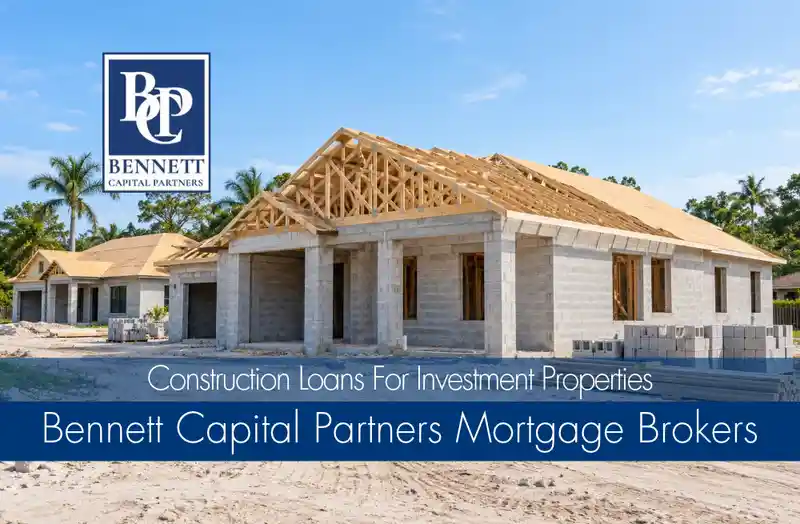
Compare construction considerations for an investment project.
Read guide
Consider the budget, builder and repayment plan for a home built for sale.
Read guide
Understand why managing your own build requires a separate lender review.
Read guideReview access, utilities, zoning information, intended use and the plan for the parcel.
View the briefCompare mortgage options for buying and improving a home or renovating through a refinance.
View the briefStart with the commercial financing hub to identify the property, loan purpose and documentation needed for a review.
View the briefCompare short-term financing for residential property acquisitions, refinances, and eligible renovations, with a defined sale or refinance exit.
View the briefBrowse financing by the property, income documentation and transaction.
Open the directorySend the land details, builder, scope and budget for a construction review.