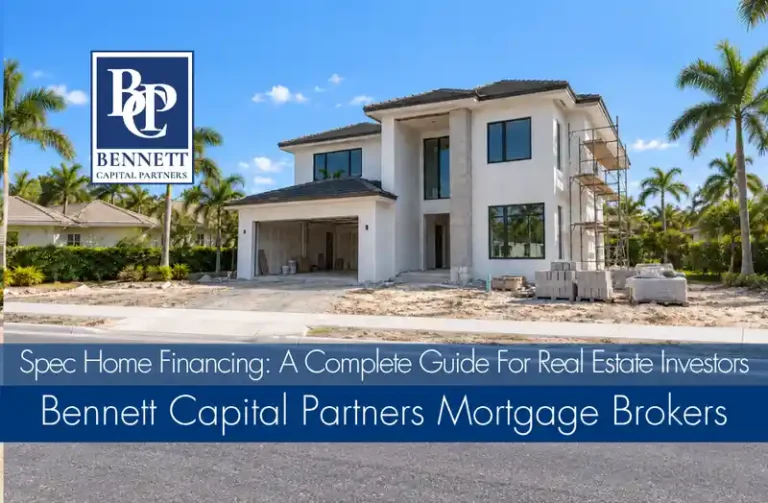
Spec home construction loans finance homes built for sale before a specific buyer is under contract. Builders and investors use these short-term loans to fund eligible land and construction costs, with advances tied to the approved budget and draw process. The project must support a realistic sale or other approved repayment plan.

Key Takeaways
- Build before finding a buyer. Spec construction loans fund eligible projects intended for sale.
- Compare lender terms. Loan size, equity, credit, guaranties, and draw rules vary.
- Plan cash between draws. Include fees, carrying costs, and contingencies in the budget.
- Use a qualified contractor. Florida's ordinary owner-builder exemption is not a shortcut for a spec home built for sale.
- Prepare the exit. Sale, extension, and rental refinance each have different conditions.
Bennett Capital Partners Mortgage Brokers helps Florida builders compare construction financing and organize the information lenders need. Loan size, leverage, pricing, experience requirements, and draw terms vary by lender and project.
This guide explains spec versus custom construction, qualification, costs, cash flow, alternative financing, and practical questions to ask before signing a loan agreement.
Whether you are planning your first spec home or managing several builds, start with the full project budget and a realistic schedule for construction and sale.
Compare the loan commitment with the cash you may need before, between, and after construction draws.
Understanding Spec Home Construction Loans
A spec construction loan is designed for a building project with a planned sale, rather than a mortgage for an owner moving into a completed home. Ground-up construction also differs from a fix-and-flip renovation. Tell the lender exactly what work is planned and how the loan will be repaid.
What is a Spec Home?
A spec home is a single-family house constructed by builders who believe buyers will want to purchase it. Spec stands for speculative, meaning the home is built before having a specific buyer in mind.
Builders and investors take a risk on what styles and features they think will sell well. They design these homes based on current market trends and popular demands. They do not tailor them to an individual's preferences like custom homes do.
Builders use spec construction loans to finance the building of these houses. These loans cover costs from purchasing land to putting up walls until the final touches are complete.
The builder normally plans to repay the loan from the sale proceeds. Terms and extension rights vary, so the construction schedule must leave time for inspections, marketing, the buyer's financing, and closing. Completion of the house does not automatically extend the loan maturity.
Spec Home vs. Custom Home Construction
Spec and custom homes allocate design decisions, market risk, and financing responsibility differently. The construction contract and loan documents determine the actual obligations. Compare the two approaches below.
For either approach, evaluate the contract, budget, draw requirements, and exit plan. A committed custom-home buyer reduces speculative sales exposure, but does not eliminate construction, contract, or financing risk.
Overview of Construction Loans
Construction loans are special funds that builders and investors use to build spec homes. These are short-term loans designed specifically for the building phase. Unlike regular home loans, construction loans give you money in stages as your project progresses.
Inspection timing and draw conditions depend on the lender. Ask whether funds are advanced before work, reimbursed afterward, or released under another approved process.
A construction loan can fund part of the land and approved building costs. The amount depends on cost, completed value, builder experience, financial strength, and the program. Financing 100% of a remaining construction budget does not necessarily mean financing 100% of the total project without borrower equity. If you need to finance the site separately, review land loan options before arranging construction financing.
Many business-purpose spec loans use an LLC or other business entity, with lender-specific guaranty requirements. Loan-to-cost, loan-to-value, land equity, and any seller subordination must be evaluated together. An advertised approval rate from another lender is not a Bennett Capital Partners approval statistic or a prediction for your application.
Significance for New Builders and Established Flippers
First-time builders may have fewer eligible programs or lower leverage. A lender can evaluate the general contractor's experience as well as the borrower's background, finances, and project. Do not assume that having a construction plan eliminates the need for equity or liquidity.
Spec construction loans can help cover eligible land, labor, and materials costs before the sale.
Experienced renovators should distinguish completed renovation projects from ground-up construction experience. A lender may assess those track records differently when deciding loan size, concurrent projects, or required oversight.
Financing can make a project possible, but it does not guarantee a faster sale or profit. Test the budget against a lower selling price, higher costs, and a longer holding period.
"As a licensed mortgage broker specializing in spec home construction loans, I've built relationships with multiple wholesale and private lenders who understand builder financing needs. Many builders choose Bennett Capital Partners because our extensive lender network provides spec construction loan options that traditional banks simply can't offer. Whether you're building your first spec home or managing multiple construction projects, our brokerage connects you with the right lender for your specific timeline and budget."
Philip Bennett, Licensed Mortgage Broker & Founder
Bennett Capital Partners, LLC (NMLS # 2046862) | Personal NMLS # 1098318
Explore Your Construction Loan Options
Compare the loan structure with your project budget and construction schedule.
- Loan Options
- Estimated Payments
- Property Review


Path for First-Time Builders
A first-time builder should make the project team and execution plan easy to evaluate. Prepare the contractor's qualifications, relevant completed work, permits, budget, timetable, and cash available for contingencies.
Challenges and Opportunities
Construction lenders review the borrower, guarantors, contractor, and proposed project. Credit standards differ; 680 is not a universal minimum. Limited experience or weaker credit may affect eligible loan size, leverage, guaranties, or approval even when a program accepts the application.
Ask which lender requirements are firm and which allow documented exceptions. Do not incur substantial application or project costs on an assumption that an exception will be granted.
Spec home financing can cover eligible land acquisition and construction costs. Confirm the approved budget, required equity, and any costs excluded from loan funding.
Payment structures vary. Some loans require monthly interest payments; others allow approved interest to accrue or use an interest reserve. No monthly payment does not mean no interest cost. Confirm how accrued interest affects the balance due at maturity.
Acting as Your Own General Contractor
For a Florida spec home intended for sale, do not rely on the ordinary owner-builder exemption to avoid contractor licensing. Florida Statutes section 489.103(7) generally limits that exemption to the owner's use or occupancy, not property built for sale or lease. Use a properly licensed contractor and confirm the permit and lender requirements. The table below describes construction-management responsibilities, not an exemption from licensing.
Evolving Lending Options
A growing record of completed projects may expand your construction financing options. Starting loan amounts and experience requirements remain lender-specific; compare programs that accept your project size and construction team.
A stronger record of completed, repaid projects may support different loan amounts or terms. The lender still reviews the current market, budget, financial position, and number of projects already underway.
Review the guaranty and recourse language carefully. Limited recourse or nonrecourse treatment, when available, can include exceptions and continuing obligations. Experience alone does not establish that a loan will have no personal guaranty.
Compare banks, private construction lenders, and other suitable capital sources on total cost, flexibility, funding reliability, and the obligations in their documents.
Costs of Building a Spec Home
A spec home budget should include land, direct construction costs, professional and permit fees, financing costs, insurance, taxes, marketing, selling costs, and a contingency. Separate the items eligible for loan funding from those you must pay with your own cash.
Map each cost to its expected payment date and the lender's draw rules. A project can appear profitable on paper and still run short of cash before a draw is available.
Direct Costs: Materials, Labor, and Land
Separate the direct project costs into materials, labor, and land.
MaterialsThis cost includes bricks, cement, lumber, roofing materials, and interior finishes. Prices can vary based on quality and quantity.
LaborYou'll pay builders, electricians, plumbers, and other tradespeople. Labor costs can rise due to skill level or project complexity.
LandIt represents the starting point of your build. Costs can be influenced by location, size, and accessibility.
Additional Expenses
Budget beyond materials and labor. The items below can affect both the cash needed during construction and the net proceeds when the home sells.
Permit Fees: Before you start, local governments require permits. These can be pricey and vary greatly from place to place.
Interest Costs: Budget for interest over the expected construction and sales period, including any scheduled rate increases.
Inspection Costs: At certain stages, your project needs an inspection. Each one of these comes with a fee.
Loan Origination Fees: Lenders often charge fees for processing your loan application. This adds to the overall cost.
Insurance Premiums: Protecting your construction site is essential. Expect to pay for various insurance policies.
Real Estate Commissions: If you sell through a realtor, you must pay commission fees. They are usually a percentage of the sale price.
Marketing can be costly. You need to spread the word about your new home. But, it's necessary to attract buyers.
Utility Connections: Hooking up water, electricity, and gas isn't free. Plan for these connection fees in your budget.
Landscaping Costs: First impressions matter. Budget for sodding, planting trees, and other landscaping work to enhance curb appeal.
Design Professional Fees: Architects or designers help create plans. But, their expertise isn't free.
Cost Overruns & Contingencies: Things don't always go as planned! Set aside extra money for unexpected issues that may arise.
Construction Budget Worksheet
Organize your construction budget with a worksheet you can keep alongside your project plans.
Download the Worksheet PDFOpens the PDF in a new tab.Managing Cash Flow and Loan Disbursements
Cash flow must cover each stage of spec home construction, from land acquisition to final fixtures. A construction spec loan releases approved funds through its agreed draw process.
These are called "draws." Each draw matches a point in your building progress.
Submit draw requests with the documentation specified in the loan agreement, which may include invoices, progress evidence, inspections, or lien-related paperwork. Confirm processing time, inspection fees, retainage, and whether the lender pays you or the contractor.
Request each draw when the required milestone is complete, allowing enough processing time to pay upcoming invoices.
Keep detailed records of invoices, payments, and construction progress. Reconcile spending with the approved budget and build schedule before requesting the next draw.
The draw schedule and loan maturity are separate terms. Ask how changes to the approved budget are handled, whether interest and fees are funded or paid separately, and what conditions and costs apply to an extension. Do not assume that an unfinished or unsold house automatically qualifies for more time.
How to Qualify and Apply for a Spec Construction Loan
To get a spec construction loan, builders and investors must meet strict criteria to be approved. The criteria hinge on their financial stability, experience, and the project's viability.
Begin by gathering the project documents and identifying lenders that finance your property type, construction scope, and experience level.
Approval Criteria
Getting a spec house construction loan involves meeting specific approval criteria. Lenders assess your creditworthiness and the project's feasibility before committing funds. Here are key factors they consider:
- Credit and guarantors: Requirements vary by lender; review credit history, guaranties, and any financial conditions.
- Project viability: Support the budget and completed value with credible plans and market evidence.
- Financial capacity: Document equity, liquidity, existing obligations, and funds for unexpected costs.
- Experience: Provide the borrower's and general contractor's relevant completed projects.
- Equity: Confirm the accepted contribution, land valuation, and when cash must be invested.
- Licensing and permits: Use appropriately licensed professionals and meet local and lender requirements.
- Detailed budget: Include hard costs, soft costs, financing, carrying costs, and contingencies.
- Schedule and exit: Allow time for completion, inspections, marketing, sale, and repayment.
Finding the Right Lender
Compare construction lenders on their relevant experience, total costs, draw process, leverage, guaranties, prepayment terms, and extension conditions. Ask for the complete terms rather than assuming every spec loan has no prepayment penalty.
Bennett Capital Partners helps Florida borrowers compare suitable construction financing options and prepare the lender package. Confirm the chosen lender's specific approval, funding, and post-closing requirements.
Application Process
Prepare your application in the following order. A complete package gives the lender the information needed to assess the project; it does not guarantee approval.
Check Eligibility
Confirm that the lender accepts the project type, Florida location, borrower, and contractor.
Understand Loan Terms
Review the rate structure, payment method, interest accrual, fees, guaranties, maturity, and extensions.
Calculate Funding
Calculate the requested loan and equity contribution using the complete budget and lender sizing rules.
Ensure Project Strength
Support completed value, market demand, construction costs, and the proposed exit.
Gather Documents
Collect plans, budget, permits or permit status, contractor qualifications, financials, and entity records.
Research Lenders
Compare lenders whose programs fit the project and your experience.
Prepare Application
Prepare a consistent package showing property details, track record, finances, equity, and schedule.
Submit Application
Submit through the agreed lender or broker process and confirm outstanding requirements.
Cooperate During Underwriting
Answer underwriting questions accurately and resolve conditions before relying on funding.
Maintain Communication
After closing, follow the approved draw process and report material project changes promptly.
Alternative Financing Options for Builders and Investors
Builders and investors may compare several financing structures. Availability depends on the collateral, business finances, construction scope, and intended repayment.
Compare each option with the project budget and repayment schedule.
Compare Alternative Financing Options
Spec home builders and real estate investors often need good financing. It supports their projects. There are several options available, each with its own benefits.
Commercial Real Estate Loans
These loans are for purchasing or developing real estate.
Investors use them to buy commercial properties like apartment buildings.
Lenders look at the property's potential income and the borrower's credit history.
- Loan maturity and amortization vary by lender and property; confirm any balloon payment and repayment conditions.
Business Lines of Credit
A line of credit gives flexibility to draw funds as needed.
It works well for managing day-to-day expenses or unexpected costs.
- Interest generally accrues on drawn funds; commitment, unused-line, or other fees may also apply.
Prequalification requirements include a solid business plan and good credit.
Blanket Loans
This type of loan covers multiple pieces of property under one mortgage.
It helps developers manage several projects simultaneously.
- Review cross-collateralization, release prices, and refinancing conditions before using several properties as security.
Investing in Spec Developments
Spec developments expose builders and investors to construction costs and the eventual sale price. Alternative financing can offer different terms from a bank loan, but greater flexibility or profitability is not guaranteed.
These options might include commercial real estate loans or business lines of credit.
As one lender-specific example, Builder Finance Inc.'s published spec program currently lists loans starting at $200,000 and up to 90% loan-to-cost, with additional conditions and possible land-subordination structures. These are that lender's published parameters, not universal limits or a Bennett Capital Partners commitment.
Compare the initial term, extension conditions, and total cost for your project. Some programs use rates that increase over time or interest that accrues to maturity. The stated first-month rate or pay rate alone does not show the full financing cost.
Land subordination can change the sources of project funding, but the land seller assumes a different lien position and risk. Obtain the lender's written structure and appropriate legal review before treating it as a substitute for cash equity.
Approval depends on the specific borrower, contractor, property, market, and underwriting. Use a written loan proposal and commitment conditions to assess feasibility; an advertised approval percentage is not a substitute.
Choose financing that leaves adequate room for cost overruns and a slower sale. A higher advance rate can reduce the initial cash contribution while increasing the balance that must be repaid.
Stay Informed with Our FREE Florida Rate Watch Newsletter! If you’re in Florida, don’t miss out on crucial rate updates. Subscribe now and make informed financial decisions.
|
|
Considerations and Best Practices
Before committing to a spec construction loan, check three contingencies: a construction delay, a sale below the projected price, and a home that remains unsold at maturity. Confirm the cash required in each case and whether the lender permits an extension or rental refinance.
Managing Project Delays and Loan Extensions
Project delays can happen even with the best plans. Loan extensions may be necessary to keep your build on track. Here's how to handle these situations:
Plan ahead for delays. Always include extra time in your schedule for unexpected issues.
Communicate early with your lender if you see a delay coming. This helps everyone stay informed.
Keep detailed records of the project’s progress. Lenders may need these when considering an extension.
Understand your loan’s terms about delays and extensions before you start building. Knowing this can save you stress later.
Consider the costs of an extension, such as fees or higher interest rates.
Aim to have a backup plan for financing in case your current lender can't extend the loan.
Schedule regular check-ins with subcontractors to identify delays early.
Document all changes that might affect the timeline. Lenders will want this information.
Selecting the Right Permanent Loans
A spec home built for sale usually repays its construction loan when the buyer closes. Permanent financing is a different exit if you intend to retain the property as a rental or for another approved purpose. Establish a realistic backup plan before the construction loan matures.
A rental refinance is not automatic. It depends on the completed property, value, eligible rent or cash flow, borrower qualifications, and the new lender's rules. The construction lender must also permit the proposed change in exit strategy.
Always compare different lenders and programs to find the best fit. Some lenders specialize in builder loans or real estate construction lending. This could help you if you're an established builder or investor in new projects.
Compare the proposed takeout loan's amount, payment, costs, and conditions with the construction balance due. If the new loan is smaller than the payoff, you may need additional cash. Avoid treating an unapproved future refinance as a guaranteed exit.
Discuss your Spec Home Financing options
Discuss your property, builder experience, equity, and repayment plan.
Get a Quote →Bennett Capital Partners: Spec Home Construction Financing

Bennett Capital Partners helps Florida builders and investors organize construction financing requests and compare suitable lender options.
The review starts with the property, budget, contractor, experience, available equity, and exit plan. The lender makes the credit decision and controls its funding requirements.
How We Evaluate Your Construction Financing
A mortgage broker can help identify lenders whose program criteria fit a spec construction project. That includes discussing loan size, location, construction scope, borrower experience, and intended repayment.
Ask which lender is considering the transaction and which requirements remain outstanding.
The financing request should match the actual project and the borrower's ability to provide equity, carry costs, and respond to unexpected expenses.
Bennett Capital Partners can help present that information clearly and compare the resulting loan options.
Matching Loan Terms to Your Project
A useful spec loan proposal addresses your budget and timeline, rather than relying on a generic advertised rate. Compare cash at closing, draw conditions, interest, fees, guaranties, maturity, and extensions.
The borrower and contractor should confirm that the funding process fits the construction schedule and subcontractor payment obligations.
Ask for clear explanations of any conditions you cannot yet satisfy. A loan offer is only useful if its funding and repayment requirements work for the project.
Our team can help Florida builders discuss the available financing paths and prepare the initial lender package.
Support During the Financing Process
Bennett Capital Partners assists with financing questions and communication during the application process. Construction management, inspections, and the lender's draw approvals remain the responsibility of the relevant project participants.
Confirm who handles each request after closing and how to contact the lender's draw team.
Keep records of approved budgets, change orders, invoices, draws, and lender conditions. Ask promptly about any change that could affect cost, completion, or the repayment plan.
Clear communication can help identify problems early, but financing does not guarantee on-time construction or sale.
Contact Us
Contact Bennett Capital Partners with the Florida property address, project scope, estimated cost and completed value, contractor information, experience, and available equity. We can discuss the initial financing questions and documents.
Call today 305-507-9957. Take the first step toward building your investment properties with confidence.
Drop us a line or visit our Miami office for personalized service in real estate financing. We give expert advice on qualifying for loans. We keep the process clear and simple.
Ask about the application process, lender responsibilities, and post-closing contacts before choosing your financing.
Conclusion
Spec home construction loans can fund eligible land and building costs while a house is being built for sale. Match the loan to a documented budget, qualified team, cash-flow plan, and realistic exit. Compare the full cost and obligations, including what happens if construction or sale takes longer than expected.
Bennett Capital Partners can help Florida builders compare the financing paths that may fit the project.
FAQs
What is a spec home construction loan?
A spec home construction loan provides financing to builders and developers who build a new house without a specific buyer lined up. The lender funds the project expecting the home to be sold after completion.
How do builders qualify for these loans?
Lenders review relevant building experience, contractor qualifications, and a documented plan for the home. Some consider first-time builders working with a qualified general contractor; others require a borrower track record. The project and borrower must meet the lender's underwriting requirements.
Are there different ways to get spec financing?
Yes. Several loan types are available, each with its own rules. Builders can apply for spec financing through regular lenders or work with specialists in construction financing.
Can anyone get a construction loan to build a spec home?
Some lenders consider first-time builders when the general contractor and project meet their requirements. Others require a stronger borrower track record. Credit, finances, equity, contractor qualifications, and the proposed project all affect eligibility; approval is not automatic.
What is the role of a broker in securing a spec construction loan?
A broker can help builders and investors obtain a spec construction loan by connecting them with lenders whose programs fit the project and guiding them through the application process.
What is a draw schedule in the context of construction loans for builders?
A draw schedule is a payment plan. It outlines when and how funds will be released to cover the costs of construction.
What are the usual loan amounts available for spec construction loans?
Loan amounts vary. They are based on the expected construction costs and the home's potential value.
What costs are typically covered by spec construction loans for builders?
These loans can cover eligible land costs, construction expenses, and related costs included in the lender-approved budget. Confirm required equity and any expenses excluded from financing.
Can conventional lenders provide spec construction loans?
Not all regular lenders offer spec construction loans, but some financing professionals and lenders do specialize in financing new building projects.