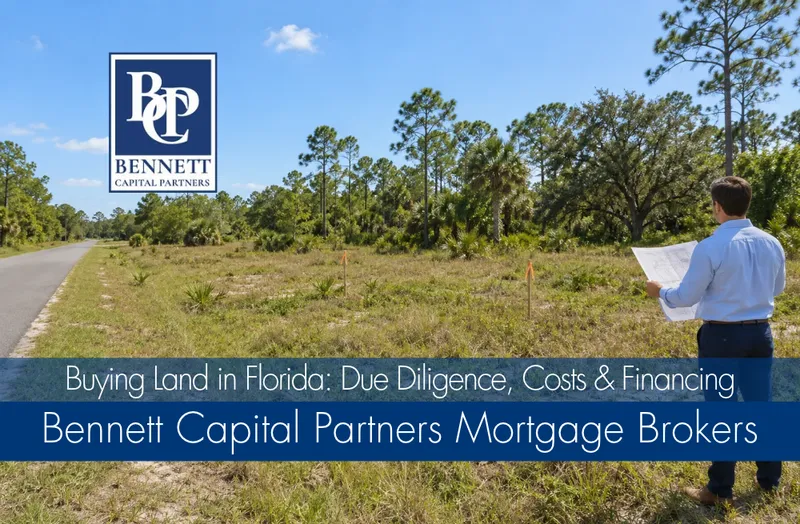
Buying land in Florida starts with confirming that the parcel can support your intended use. Before you commit, verify legal access, zoning, the usable building area, flood and wetland constraints, utilities and the full project budget. Then match financing to the property and your build timeline.
Key Takeaways
- Verify the parcel before closing: access, zoning, flood exposure, wetlands, utilities and the usable building area all affect what you can do with the land.
- Budget beyond the purchase price: include investigations, closing expenses, site work, permits, holding costs and a contingency reserve.
- Match financing to the project: compare land loans and construction financing early, with a separate review of the borrower, parcel and build plan.
This guide helps you investigate a lot or acreage before closing, compare purchase costs and prepare for a financing review. A low-priced parcel can become expensive when site work, approvals or access problems enter the picture.
Bennett Capital Partners Mortgage Brokers helps borrowers evaluate land financing. The sections below explain what to gather so the property review and the loan discussion can move forward together.
Researching Land for Sale in Florida
Start with what you want to do with the parcel: build a primary home, hold it for a later project, farm, or use it for recreation. That decision determines which listings deserve your time. A low purchase price does not help if the land cannot support your intended use.
When comparing Florida land for sale, request the parcel identification number, legal description, survey and available property records. Street addresses and listing pins can be incomplete. Match the land you visit to the land described in the purchase contract.
Raw land, improved lots and buildable property
Listing descriptions are starting points. Ask what improvements actually exist and which approvals remain outstanding. “Residential zoning” and “utilities nearby” do not establish that you can build a particular house.
| Land description | What to verify | Budget implication |
|---|---|---|
| Raw or unimproved land | Legal access, usable area, power, water, wastewater and required approvals. | Site preparation and infrastructure may be major expenses beyond the purchase. |
| Improved or finished lot | Which utilities and roads are installed, whether connections are paid, and any remaining conditions. | Existing infrastructure can reduce work, but connection, impact and permit fees may remain. |
| Land advertised as buildable | Whether your proposed footprint, access and wastewater solution satisfy the applicable requirements. | Price the specific project, including any elevation, drainage or engineering work. |
Explore Florida Land Financing
Discuss financing options for your property and financial goals.
- Loan Options
- Estimated Payments
- Property Review


Use official records to check the listing
Use the Florida directory of county property officials to find the property appraiser, tax collector and clerk. These offices have different roles. Assessment records help identify a parcel; recorded documents and professional title review address ownership and encumbrances. Neither an assessed value nor a tax classification is a building approval.
For an incorporated property, start with the city planning department; for unincorporated land, start with the county. Ask about current zoning, future land use, minimum lot dimensions, setbacks, density and any subdivision restrictions. Obtain the relevant answers in writing and keep them with your due-diligence file.
Build the right team around the parcel
A real estate agent experienced in local land transactions can help compare sales and negotiate an inspection period. A surveyor, title professional, attorney, environmental consultant and builder answer different questions. A mortgage broker evaluates financing. Do not assume one professional’s review replaces the others.
Compare properties by usable area and development cost as well as price per acre. A rural tract with road frontage, power and a feasible homesite is a different purchase from the same acreage without recorded access. A waterfront or beach-area lot needs its own review of flood exposure, coastal restrictions and construction costs.
How to choose a Florida county or region
Choose the location around your intended use rather than a statewide list of “best” counties. For a primary home, test the actual commute and distance to daily services. For a vacation property, consider travel time, maintenance while you are away and whether your intended occupancy is permitted. For acreage, compare road access, management costs and the activities the property can support.
If you are comparing Miami-Dade or Broward lots with acreage in North Florida, build a separate budget for each actual parcel. Likewise, compare a Port Charlotte lot with a Central Florida property using the same checklist: usable area, utility connections, local approvals and total cost. County names do not tell you whether a specific lot is buildable, affordable or a good investment. A local land agent can help you find comparable closed sales; the relevant city or county must address the land-use questions.
Before You Buy: Florida Land Due-Diligence Checklist
Complete these checks while you still have the contractual ability to investigate, renegotiate or cancel. Have your agent or attorney explain the actual deadlines, notice requirements and deposit provisions in your contract.
- Legal and physical access: Confirm frontage on a public road or an adequate recorded access easement. Ask who maintains a private road and whether emergency vehicles and construction equipment can reach the site.
- Buildable footprint: Overlay boundaries, setbacks, easements, wetlands and drainage areas on the proposed layout. Total acreage is not the same as usable acreage.
- Flood exposure: Review the FEMA map, then discuss elevation, drainage and building requirements with the local floodplain administrator. Price any required elevation work and insurance before committing.
- Wetlands: Treat online maps as screening tools. If wetlands may affect the homesite, driveway or utilities, obtain qualified field review and determine what agency approvals are needed.
- Water and wastewater: Get written utility availability and connection estimates. If the parcel needs a well or septic system, establish feasibility and permitting requirements before assuming either will work.
- Title and private restrictions: Review the title commitment, exceptions, recorded easements, deed restrictions, association rules, liens and assessments with the appropriate professionals.
- Project and financing fit: Confirm that the intended use, build schedule and total cost fit both your budget and the proposed financing.
FEMA’s Flood Map Service Center is the official starting point for mapped flood hazards. A map review is not a guarantee that a property will never flood. Also examine the actual site, drainage patterns and available local information.
For wetlands, Florida DEP explains how a formal wetland boundary determination differs from a preliminary map. A parcel can include both uplands and wetlands; the practical question is whether the planned improvements can be located and permitted where you need them.
For septic, review DEP’s onsite sewage permitting guidance and contact the permitting office responsible for the county. Soil, water-table conditions and the proposed use affect the review. A neighboring home’s septic system does not establish approval for your lot.
What Does Buying Land in Florida Really Cost?
Separate the land price from the cost of making it usable. Request written estimates before treating an inexpensive listing as a good deal. A seller’s old estimate may not reflect your design or current site conditions.
| Cost category | Items to investigate |
|---|---|
| Acquisition and closing | Purchase price, title and settlement charges, recording and applicable taxes, loan fees and appraisal. |
| Due diligence | Survey, legal review, environmental evaluation, soil testing and preliminary engineering. |
| Site preparation | Clearing, grading, drainage, driveway, fill where permitted, and utility or well and septic work. |
| Permits and connections | Building and site permits, impact fees, utility capacity or connection charges, and association approvals. |
| Holding and contingency | Property taxes, financing payments, insurance where appropriate, maintenance, association charges and a reserve for unexpected work. |
Hypothetical budget: A $100,000 parcel plus $5,000 for acquisition-related expenses, $20,000 for site work, $5,000 for holding costs and a $10,000 contingency produces a $140,000 budget before home construction. These are illustrative amounts, not Florida averages, a quote or a financing offer. The example shows why comparing only listing prices can understate the money you need.
Check the current tax bill and ask the property appraiser about assessment changes after a sale or change of use. Do not assume you inherit the seller’s exemptions or agricultural classification. Florida’s homestead exemption guidance ties eligibility to ownership and permanent residence; a plan to build a future home does not by itself establish eligibility.
Financing Options for Buying Land in Florida
A vacant parcel generally needs land-specific financing rather than an ordinary mortgage for a completed home. The appropriate route depends on the property, your intended use, available cash and how soon you will build. Start this conversation before making an offer with a financing deadline.
Compare how each financing route works
| Funding route | Potential fit | Important question |
|---|---|---|
| Land or lot loan | Purchasing an eligible parcel before construction is ready to begin. | Does the program accept this land type, intended use and build timeline? Confirm cash required, repayment schedule and any balloon payment. |
| Construction financing | Purchasing land as part of an approved building project, when the program permits it. | Are the builder, plans, budget, permits and draw process acceptable, and how is permanent financing arranged? |
| Seller financing | A sale where the owner agrees to finance part of the purchase. | What do the note and security documents require, including interest, default remedies, lien priority and any balloon balance? |
| Home equity borrowing | Using available equity in another home, subject to approval and a repayment plan. | Can you afford the added obligation, and are you prepared to put that home at risk as collateral? |
| Cash purchase | Buying without a loan secured by the parcel at closing. | Will enough liquidity remain for due diligence, site work, holding costs and construction? |
The CFPB explains that construction loans usually release funds in stages. Permanent financing may be part of the arrangement or may require a separate application. Do not assume a land loan automatically converts into a construction loan or a long-term home mortgage.
If you consider a HELOC, review the CFPB’s explanation of home equity lines of credit. The debt is secured by your home, and payments can change between the draw and repayment periods. Buying the parcel with borrowed equity does not eliminate financing risk.
Compare the whole loan, not just the interest rate
Request the down payment, fees, term, amortization, payment structure, prepayment conditions and any balloon balance in writing. Ask whether the valuation supports the purchase price and what happens if it does not. A low monthly payment can leave a substantial balance due sooner than expected.
There is no single down-payment percentage that applies to every Florida land purchase. Avoid budgeting from a generic online minimum. Underwriting must account for the borrower and the specific parcel, and construction financing is a separate review.
Prepare Your Land Financing Review
Bennett Capital Partners Mortgage Brokers can review your purchase scenario and help identify an appropriate financing path. Our Florida land loan page covers land-financing considerations in more detail. If your builder and project are already taking shape, review construction loan options alongside the acquisition plan.
Documents that make the first conversation useful
- Parcel information: Address, county, parcel number, listing and proposed purchase price.
- Property evidence: Survey, access information, zoning details and available utility or environmental reports.
- Project plan: Intended use, estimated build date, builder information and preliminary budget, if available.
- Financial outline: Available down payment and reserves, income documentation, existing debts and requested financing amount.
- Contract timing: Offer or signed agreement, inspection deadline, financing deadline and proposed closing date.
Buying Land to Build a House: Check Feasibility First
Bring a builder or other qualified professional into the review before closing, even if construction will start later. You need to know whether the house, driveway, drainage and wastewater system can fit within the usable area at an acceptable cost.
Match the survey, zoning and proposed layout
A boundary survey identifies the surveyed boundaries and relevant features within its scope. Planning review addresses permitted uses and development standards. Title review addresses recorded rights and restrictions. Read these together: an easement or setback can affect a homesite that looks practical on an aerial photograph.
Choose a builder with relevant local experience
Check the contractor’s status through Florida’s DBPR license search, then discuss insurance, references, site-work responsibility and written allowances. Ask who pays if soil conditions, utility work or required engineering exceed the initial estimate.
Confirm permits, fees and the build schedule
Ask the applicable local departments for the approvals your project requires and the information needed to estimate fees. Land-use approval, environmental authorization, driveway access, wastewater approval and a building permit can involve separate reviews. Do not treat one approval as permission for all work.
If you plan to buy now and build later, examine association construction deadlines, maintenance obligations and loan terms before choosing that approach. Keep enough cash for the holding period and avoid relying on future refinancing that has not been approved.
Stay Informed with Our FREE Florida Rate Watch Newsletter! If you’re in Florida, don’t miss out on crucial rate updates. Subscribe now and make informed financial decisions.
|
|
From Offer to Closing: A Practical Purchase Process
- Set the use and total budget.
Define what the parcel must support, how much cash you can commit and the costs beyond the purchase price.
- Screen the property and financing.
Review the parcel records, access and likely development constraints. Discuss financing before agreeing to deadlines you cannot meet.
- Negotiate an investigation period.
Have the purchase agreement reviewed for contingencies, access for inspections, required notices and deposit treatment. Allow time for the actual reports your parcel needs.
- Resolve the findings.
Complete inspections, survey and title review, obtain cost estimates, and address financing conditions. Request extensions before deadlines if needed; do not assume they are automatic.
- Review and close.
Confirm the final legal description, title documents, settlement figures and loan obligations with the closing professionals. Keep the recorded deed, survey, reports and approvals for your future project.
Visit the site and document what you find
Walk the accessible areas with permission. Look for standing water, drainage paths, debris, encroachments and differences between the listing and actual access. A site visit informs the professional review; it cannot establish wetland boundaries or replace a survey.
Check surrounding development plans
Review the local future land-use map and ask about nearby road projects or proposed development. Consider how changes could affect noise, access and your intended use. Neither proposed development nor a growing population guarantees appreciation.
Negotiate from verified costs
Use comparable closed sales and documented site expenses to evaluate the asking price. If a new estimate changes the project economics, discuss the available contractual options before the relevant deadline. Walking away from an unsuitable parcel can be the better financial decision.
Understand what title review does and does not cover
Ask your title company or attorney to explain the title commitment and exceptions, including access rights, liens and restrictions. Title insurance has specific coverage and exclusions. It does not establish that a parcel will receive building approval or that the project will fit your budget.
Make the Parcel, Budget and Financing Work Together
The best land purchase for your situation is one that supports your intended use at a total cost you can afford. Verify the site before removing protections, price the work beyond the land itself, and choose financing that fits the build schedule. Use our land financing guide to prepare the next conversation with Bennett Capital Partners.
Buying Land in Florida: Frequently Asked Questions
What do you need to buy land in Florida?
Start with a defined use, a total budget and a parcel you can investigate. Before closing, complete the appropriate title, survey, access, zoning, environmental and utility checks. If borrowing, obtain approval for both your financial profile and the specific property. Your purchase contract determines the deadlines and protections available.
How do I find out whether land is buildable?
Ask the applicable city or county planning office about your intended use, setbacks and development standards. Combine that response with a survey, title review, utility or septic feasibility and any necessary environmental evaluation. Residential zoning alone does not prove that your proposed house can be permitted.
How much down payment do I need for a land loan?
There is no universal Florida minimum. The amount depends on the financing program, parcel, intended use, valuation and borrower. Request a written scenario review before budgeting around a percentage. Reserve cash separately for closing expenses, investigations and site work.
Why is some land in Florida so cheap?
A low asking price may reflect remote location, weak demand, limited access, wetlands, flood exposure, missing infrastructure or restrictions. It can also reflect a seller’s circumstances. Investigate the specific parcel and compare usable area and total project cost before deciding whether it is a bargain.
Can I buy land in a flood zone or with wetlands?
A mapped flood zone or wetland area does not answer every purchase or building question. Establish where your planned improvements would go, what approvals and design measures are required, and whether the remaining usable area works. Flood mapping and wetland review are separate investigations; one does not replace the other.
Can I buy land now and build a house later?
That can be possible if the parcel, financing and private restrictions allow it. Check construction deadlines, maintenance obligations and holding costs. A later construction loan requires its own approval; buying the land does not guarantee that financing.
Is owner financing a good option for a land purchase?
Seller financing may be useful when the seller agrees to suitable terms, but compare the full obligation. Have an attorney review the documents, title, lien position, default provisions and any balloon payment. Confirm how you will repay the debt without assuming refinancing will be available.
Can an out-of-state buyer purchase Florida land?
Living in another U.S. state generally does not by itself prevent a purchase. Foreign ownership and some entities require a separate legal review: Florida has restrictions involving certain foreign interests and property types. Have a Florida attorney assess applicability and current enforceability for your circumstances before signing.
Is buying vacant land a good investment?
It depends on the purchase price, permitted use, development costs, carrying expenses and resale demand. Undeveloped land may produce no income while you pay taxes and other costs. Model the holding period and exit plan without assuming appreciation or future rezoning.
What should I check before buying rural acreage?
Focus on recorded access, road maintenance, usable acreage, utilities, wastewater feasibility and permitted activities. Investigate leases, easements and tax classifications that may affect the property. Price the cost of managing the whole tract, not just the proposed homesite.
For the foreign-ownership issue above, see Florida Statutes, Chapter 692, Part III.
Discuss your Florida Land Financing options
Discuss your financing scenario with Bennett Capital Partners.
Get a Quote →