
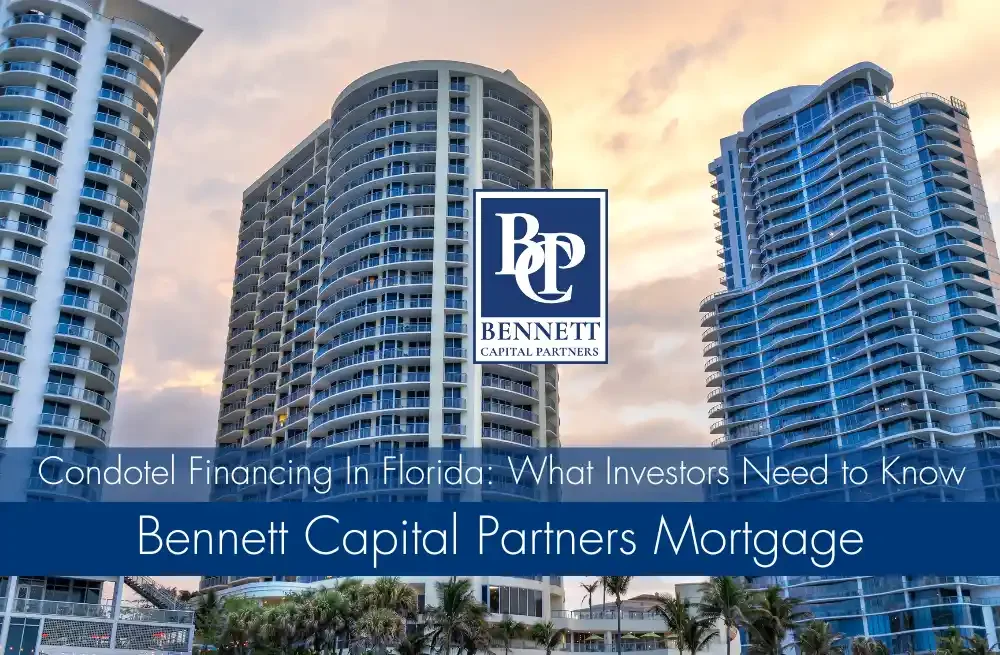
Condotel financing in Florida starts with the building, its hotel operation, and the way you plan to use the unit. Specialty financing may be available, but a standard condo preapproval does not establish that a condo hotel qualifies.
Key Takeaways
- Review the project and borrower separately. Rental agreements, hotel operations, and owner-use restrictions can affect financing.
- Get property-specific requirements. Down payment, credit, reserves, and income documentation are not universal across condotel programs.
- Evaluate net income. Management charges, association dues, insurance, taxes, and mortgage payments can outweigh attractive bookings.
- Read the ownership documents. Confirm your use rights, shared-facility costs, and applicable building inspection and reserve records.
This guide explains the property review, borrower requirements, rental-income questions, and ownership costs to investigate before buying or refinancing. For a review of your specific unit, Bennett Capital Partners Mortgage Brokers offers condotel financing assistance.
What is a condotel, and why is financing different?
A condotel, also called a condo hotel or condo-tel, is an individually owned condominium unit in a property with hotel-style operations. Owners may receive rental revenue through an operator while retaining the personal-use rights allowed by their agreement. Ownership of the unit does not necessarily give you control over bookings, fees, or access to shared amenities.
The financing issue is how the project operates. Fannie Mae identifies projects managed and operated as hotels as ineligible under its condo project standards. A strong credit profile or a loan amount below the conforming limit does not resolve that project restriction.
Why is condotel financing more complex? The review extends beyond your ability to make the payment. Rental-pooling arrangements, revenue sharing, hotel management, and restrictions on owner occupancy can affect project eligibility. Fannie Mae identifies these hotel-operation characteristics in its standards. A specialty financing review therefore needs the operating agreements as well as your financial documents; an appealing unit or recognizable hotel brand cannot substitute for that review. Our condo financing overview explains the borrower and building review.
Condotel vs. non-warrantable condo vs. short-term rental
| Property type | What it means | Financing question |
|---|---|---|
| Condotel | An individual unit within a hotel-style operation. | Does the program accept this project's rental agreement, services, and occupancy restrictions? |
| Non-warrantable condo | A project that fails one or more applicable agency condo requirements, for reasons that can extend beyond hotel use. | Which specific project issue prevents standard financing, and can a specialty program address it? |
| Short-term rental | A rental use, not a separate ownership structure. The property could be a house, condo, or condotel. | Is the rental use permitted, and does the property meet the selected loan's eligibility rules? |
Explore Condotel Financing
Review your condo-hotel property, intended use, and financing options with Bennett Capital Partners.
- Loan Options
- Estimated Payments
- Property Review


Permission to rent a condo for short stays does not by itself settle its classification. Fannie Mae's Project Standards FAQs distinguish limited seasonal rentals from projects that are primarily transient or have other condotel characteristics. Review the actual documents and operation before choosing between non-warrantable condo financing and a short-term rental loan.
Condotel loan requirements: review the property first
Condotel financing has two separate reviews: whether the lender accepts the project and whether you qualify for the mortgage. A borrower preapproval should not be treated as approval of an unidentified condo-hotel building.
What does a condotel preapproval cover? Ask which income, credit, asset, and liability information has been reviewed and which assumptions remain. The CFPB explains that a preapproval letter is not a guaranteed loan offer. For a condo hotel, also request the status of the separate building review. Before committing funds, ask your mortgage broker to identify outstanding project documents, appraisal requirements, and underwriting conditions, and coordinate those items with your contract deadlines.
A practical process for getting financing
- Identify the unit and intended use
Start with the address, unit number, purchase price or estimated value, and whether you are buying or refinancing. Explain any planned personal stays and rental use.
- Review the project's operating documents
Obtain the condominium declaration, rental-management agreement, owner-use rules, association budget, insurance information, and available inspection records. Identify who controls the rental operation and common facilities.
- Match the borrower to an eligible program
Discuss credit, funds for closing, reserves, ownership structure, and the accepted income method. Request a scenario review for this specific building before relying on a generic quote.
- Confirm the remaining underwriting conditions
Ask which appraisal, title, project, insurance, and income items remain outstanding. Coordinate the financing timeline with your purchase contract and professional advisers.
Down payment, credit score, reserves, and income
There is no single Florida condotel down payment or minimum credit score that applies to every mortgage lender. Get written terms for the building, loan purpose, occupancy, and documentation route being considered. A percentage quoted for an ordinary condo or a different condotel is not confirmation for your transaction.
- Down payment and loan-to-value: Request both the maximum loan amount and the value basis used to calculate it. Include closing costs and required reserves in your cash budget.
- Credit and liabilities: Identify the applicable credit standard and whether qualification uses personal income and debt-to-income calculations or a property-income method.
- Cash reserves: Ask how much must remain after closing, which assets count, and whether other financed properties affect the requirement.
- Income evidence: Establish what the lender will accept before ordering projections or collecting statements. Gross bookings, owner distributions, and qualifying rental income are different figures.
Financing options depend on property eligibility
Specialty condo hotel financing may use different ways to document repayment capacity. These labels describe potential underwriting routes; none automatically makes a condotel eligible.
Choose the income route before comparing loan terms. For a salaried buyer, ask whether documented employment income can support qualification when the unit's rental income is insufficient. A self-employed buyer can discuss a bank statement analysis, while an investor can ask about a DSCR program that evaluates accepted property income against its defined debt-service obligation. The table below separates these routes and the evidence to prepare.
Also separate income documentation from loan structure. A jumbo loan describes the loan size relative to conforming limits; it does not tell you whether salary, bank statements, or rental income will be used. Ask which fixed-rate or adjustable-rate terms are available for the approved property and chosen documentation route.
| Route to discuss | Evidence to prepare | Condition to confirm |
|---|---|---|
| Documented personal income | Employment or business income records, assets, and liabilities. | The program must accept the condo-hotel project and your intended occupancy. |
| Bank statement loans | Self-employment history and the statements requested for the income analysis. | Qualifying business income is not simply total deposits; transfers and expenses need review. |
| DSCR loan | The rental history or other income evidence accepted by the investment-property program. | Confirm explicit condotel eligibility, the qualifying-income calculation, and occupancy restrictions. |
| Foreign national financing | Identity, residency, income or assets, and documented funds as requested. | Both the borrower profile and the particular project must fit an available program. |
Our DSCR loan overview explains the property-income approach. For self-employed buyers, the Florida bank statement mortgage guide explains the documentation distinction. Neither route overrides a lender's property restrictions. A jumbo loan amount or a non-QM label also does not establish condotel eligibility. Our non-warrantable condominium financing guide explains the broader project category.
Case study: Delayed financing for a 390-square-foot Ritz-Carlton condotel
In a transaction handled by Bennett Capital Partners, a borrower paid cash for a 390-square-foot condotel unit at a Ritz-Carlton-branded property, then obtained delayed financing after the purchase.
The size challenge: Many of the lending options considered required a minimum unit size of 500 square feet. We arranged financing with a lender that approved an exception for this 390-square-foot unit.
The income solution: The unit did not qualify on its rental income alone. The borrower instead qualified using salary income to cover the debt service, rather than relying solely on the property's debt service coverage ratio (DSCR).
The outcome: The delayed-financing transaction closed. The lender's acceptance of the smaller unit and the borrower's salary-based qualification made this particular transaction possible.
This case illustrates why unit size, the income qualification method, and financing after a cash purchase need to be reviewed together. The approval was specific to this borrower and property.
How to compare condotel mortgage rates and fees
Compare written offers for the same building, loan amount, use, and lock period. Review the interest rate, points, lender fees, amortization, fixed or adjustable structure, and any prepayment penalty or balloon payment. A lower initial payment can come with a different long-term cost or repayment obligation.
The CFPB's guide to comparing loan offers is useful for consumer mortgages. For business-purpose financing, request a complete written term and cost breakdown; do not assume the same consumer disclosure forms apply.
Owning a condotel: benefits, costs, and rental income
The attraction is a unit with hospitality services and potential rental revenue. The financial decision depends on what you keep after operating charges and mortgage payments, plus the control you retain under the governing agreements.
Potential Benefits
- Professional guest operations
An operator may handle reservations, check-in, and housekeeping, reducing your day-to-day involvement.
- Personal-use opportunities
Permitted stays can make ownership useful beyond rental revenue when both the agreement and financing allow them.
- Access to amenities
Hotel-style facilities may appeal to guests and owners. Confirm which services are included and which cost extra.
Costs & Trade-Offs
- Charges before distributions
Management, booking, cleaning, furnishing, and other deductions can materially reduce the owner's share of revenue.
- Restrictions on control
Rental pools, blackout dates, required furnishings, and operator contracts can limit how you use or manage the unit.
- Exposure to changing costs
Seasonal bookings, insurance, association dues, and special assessments can strain cash flow. Financing and resale options may be narrower.
Assess seasonal rental income before relying on it
Review monthly results rather than multiplying a peak-season nightly rate by a full year. Compare booked nights, achieved rates, owner-use dates, cancellations, and management deductions across the available records. Ask how your budget would hold up during a slower season or a period when the unit is unavailable. Keep that investment analysis separate from the rental income the lender accepts for qualification.
Rental income example: gross bookings are not cash flow
Hypothetical annual illustration only: These invented figures explain the calculation, not expected returns, typical fees, or a loan offer. Assume the booking figure excludes guest taxes and refundable deposits, and each expense is counted once.
| Cash-flow item | Annual amount |
|---|---|
| Gross rental bookings | $60,000 |
| Management and booking charges | −$18,000 |
| Association dues | −$12,000 |
| Property taxes and insurance | −$6,000 |
| Other operating costs and replacement allowance | −$4,000 |
| Available before mortgage payments | $20,000 |
| Mortgage principal and interest payments | −$24,000 |
| Cash flow before income taxes | −$4,000 |
In this example, substantial bookings still leave the owner contributing $4,000 annually. Test a lower-revenue year and a special assessment separately. Avoid subtracting costs twice when the operator's statement already reports net distributions. This ownership budget is not a lender's DSCR calculation.
Also establish who collects and remits applicable lodging taxes. Florida's transient rental tax guidance explains that county taxes can apply alongside state sales tax and surtax. Money collected for taxes should not be treated as your rental profit.
Is the Florida condotel right for your investment plan?
For condotels in South Florida, Orlando, or another Florida market, examine the specific project and its records. A familiar hotel brand, waterfront location, or attractive nightly rate is not evidence of mortgage approval or a profitable investment.
Documents to request before committing to the purchase
- Rental and owner-use agreements: Review mandatory participation, management fees, termination rights, blackout dates, and responsibility for furnishings and repairs.
- Actual operating records: Request available unit-level booking history, owner statements, occupancy records, and a breakdown of deductions. Separate seller projections from documented results.
- Association finances: Review the budget, dues, reserve information, special assessments, and relevant meeting records. Ask which costs are outside the association budget.
- Building condition and insurance: Obtain applicable milestone inspection reports, structural integrity reserve studies, repair information, and insurance documents. Determine what remains unresolved.
- Ownership and shared facilities: Identify who owns and controls the lobby, amenities, and other areas outside the residential condominium, and how their costs are allocated.
Florida DBPR explains the difference between a milestone inspection and a structural integrity reserve study: one examines structural condition, while the other addresses reserves for specified building components. Their applicability depends on the building; obtain the relevant records rather than assuming every project has identical obligations.
In some mixed-ownership developments, the condominium occupies only part of the building. Florida Realtors' condotel ownership and disclosure explanation highlights why buyers need to understand control and maintenance charges for other areas. Have your real estate attorney review those provisions before relying on a sales summary.
Start with a review of your condo-hotel financing scenario
Condotel financing is a regular part of our work at Bennett Capital Partners. Send the property address, unit number, purchase or refinance goal, estimated price or value, and intended use. Include the rental agreement and available operating statements so the initial discussion can address the actual property.
Our Florida condotel loan program page is the next step for a property-specific financing review. Use this guide to prepare your questions and documents before comparing terms.
Stay Informed with Our FREE Florida Rate Watch Newsletter! If you’re in Florida, don’t miss out on crucial rate updates. Subscribe now and make informed financial decisions.
|
|
Condotel financing in Florida: frequently asked questions
Can you finance a condotel in Florida?
Financing may be available through specialty programs that accept condo-hotel properties. Approval requires review of the building's operation, the individual unit, your intended use, and your qualifications. A mortgage preapproval for a standard condo does not establish condotel eligibility.
How much down payment do you need for a condotel?
There is no universal percentage. Request the maximum loan-to-value and required cash for your specific building and borrower profile. Your total cash need includes the down payment, closing costs, and any reserves required after closing.
Does allowing nightly rentals make a condo a condotel?
Not necessarily. The review considers the project's actual use, hotel-style services, rental arrangements, and occupancy restrictions. Fannie Mae distinguishes limited seasonal rentals from a primarily transient project. The listing's description alone does not decide the classification.
Can projected rental income qualify me for the loan?
Only if the selected program accepts that income method and the project. Ask whether underwriting requires historical owner statements, an appraisal-supported estimate, or other evidence, and which expenses or adjustments apply. A seller's revenue projection is not an approval.
Can I use a DSCR loan for a condo hotel?
Potentially, but the DSCR program must explicitly accept condotels. Confirm the permitted occupancy, rental-income evidence, and calculation before relying on a debt service coverage ratio. Ordinary short-term-rental eligibility does not automatically include a hotel-operated project.
Can I stay in my condotel or use it as a primary residence?
Check both the project agreement and the mortgage terms. Owner stays may be restricted by rental commitments or blackout dates, and investment-property financing may restrict personal occupancy. Do not assume a condotel can be your primary residence or that permission from the operator satisfies the loan's occupancy rules.
Can I refinance a condotel or take cash out?
A refinance may be possible when an available program accepts the project, borrower, and transaction. Review current value, equity, title history, rental records, insurance, and any existing prepayment penalty. Ask separately about cash-out eligibility and limits; a purchase approval does not establish refinance terms.
What should I send for an initial condotel financing review?
Start with the address and unit number, purchase price or estimated value, loan amount, intended occupancy, and whether you are buying or refinancing. Add the rental-management agreement and available association and operating records. Bennett Capital Partners can then identify the information needed for a property-specific review.
Discuss your Condotel Financing options
Review condotel financing, rental terms, and your property goals.
Get a Quote →