Flex space is commercial real estate that combines office or showroom space with warehouse, storage or light industrial use. In Florida, the right property can bring several parts of a business together, provided the layout, zoning and costs fit the operation. Review our commercial mortgages page for program details.
Key Takeaways
- Flex space combines office and operational areas; it does not automatically include short leases or permission for every business use.
- Confirm zoning, loading access, electrical capacity, parking and insurance before committing to a Florida property.
- Compare base rent with NNN charges, utilities, improvements and other obligations to estimate the full occupancy cost.
- Owner-occupied business financing and investor rental-property financing follow different eligibility and underwriting paths.
- Check property records and local lease comparables. Cost savings, appreciation and fast financing are not guaranteed.
This article provides general information about flex space properties for educational purposes only. Property investment decisions should be based on individual financial circumstances and professional advice. Past performance and market trends do not guarantee future results. |
What Is Flex Space in Commercial Real Estate?
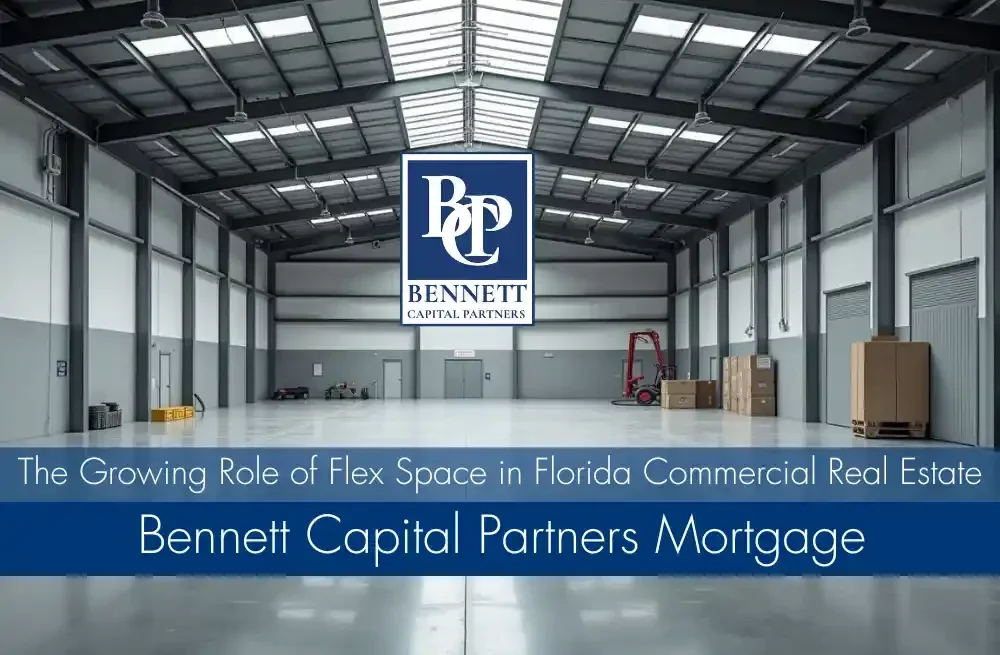
Flex space combines office or showroom space with warehouse, storage or light industrial space in the same commercial property. A business can handle customer meetings, administration and physical operations at one address. A flex unit is one separately occupied suite within that property.
Many flex space buildings are single-story, with a customer entrance in front and loading access at the side or rear. The office-to-warehouse ratio varies. Check the actual floor plan: a listing labeled “flex” does not tell you how much usable storage, conditioned workspace or loading capacity it provides.
Flex warehouse, traditional office or coworking?
- Flex warehouse space
- Combines office work with inventory storage, packing, assembly or other permitted operations. Look for usable clear height, loading doors and a floor plan that separates customers from work areas.
- Traditional office space
- Prioritizes desks, meeting rooms and professional services. Office buildings generally are not configured for pallet deliveries, noisy equipment or substantial warehouse operations.
- Coworking and flexible office spaces
- Usually provide a desk or private office with shared amenities. Flexible leasing may be available, but warehouse space and industrial uses are not implied.
- A storage unit
- Serves a different purpose. Permission to store goods does not automatically authorize employees, customers, manufacturing or daily business operations inside the unit.
Physical adaptability and flexible lease terms are separate questions. Some operators offer month-to-month rentals; other commercial flex space requires a multiyear commitment. Read the proposed commercial lease before assuming that you can expand, leave early or change the use.
Explore Flex Space Financing
Discuss your property and financing goals with Bennett Capital Partners.
- Loan Options
- Estimated Payments
- Property Review


Choosing a Florida Location That Fits Your Business
Start with the trips your business actually makes. A contractor may need convenient access to customers and suppliers. A distributor may prioritize truck routes and loading access. A showroom may need visible signage, visitor parking and a welcoming entrance more than proximity to a port.
Tour the property during operating hours. Check turning space, delivery restrictions, employee parking, nearby homes and the time needed to reach major roads. A location near I-95 or I-75 can still have a difficult final approach for trucks.
Confirm permitted use with the city or county that has jurisdiction over the address. In the City of Miami, the Certificate of Use process includes zoning review and required inspections. Approval for a previous occupant does not establish that your proposed business can operate there.
Who Uses Flex Space, and What Drives Florida Demand?
Small businesses that need both a workplace and room for physical goods are natural candidates. Examples include e-commerce sellers, service businesses storing tools and materials, distributors, makers and light manufacturing operations. A studio or research business may also fit, but specialized ventilation, plumbing, power or permits can change the economics.
For a startup, combining office and warehouse functions can reduce travel between multiple locations. Growing businesses should also plan for their next stage: additional employees may need more parking and restrooms before the inventory fills the building.
Read local market reports carefully
Florida is not one uniform industrial market. Compare properties in the same submarket, size range and condition. A statewide growth story cannot establish the achievable rent or vacancy risk for a particular flex property.
CBRE's Miami Industrial Figures for Q3 2026, published October 7, 2026, reported 1.27 million square feet of net absorption during the quarter, bringing the year-to-date total to 2.63 million square feet. That report covers the wider industrial market, including large buildings; it is not a flex-space vacancy measure.
Ask a local commercial broker for comparable signed leases, current competing units and concessions. Listing prices show what owners are asking, which can differ from completed transactions.
How Much Does Flex Space Cost to Lease?
Compare the full occupancy cost, not just the advertised rent per square foot. A flex lease may be gross, modified gross or triple net (NNN). In a NNN arrangement, the tenant generally pays allocated property taxes, insurance and maintenance charges in addition to base rent. The contract determines the precise obligations.
Confirm whether the quoted rate is annual or monthly, what area it applies to and which charges are estimates subject to reconciliation. Ask who pays for roof repairs, HVAC replacement, utilities, waste collection and shared-area expenses.
A simple monthly cost example
The following is a hypothetical illustration, not a Florida market quote. Assume a 3,000-square-foot unit with annual base rent of $18 per square foot and estimated annual NNN charges of $6 per square foot.
- Base rent: $4,500 per month
- 3,000 square feet × $18 ÷ 12 months.
- Estimated NNN charges: $1,500 per month
- 3,000 square feet × $6 ÷ 12 months.
- Combined estimate: $6,000 per month
- Before utilities, business insurance, deposits, improvements and any other contractual charges. Actual NNN expenses may change.
Budget separately for build-out, permits, professional fees, moving and downtime. Obtain written bids for improvements; there is no single reliable customization cost for every flex space unit. A low asking rent can become expensive if the building needs major electrical or fire-safety work. Use our commercial mortgage calculator to compare estimates using your own figures.
Leasing versus buying
Leasing may suit a business with uncertain space needs or limited capital for a purchase. Buying can offer more control over the property, subject to zoning, association restrictions and financing terms. It also commits cash to the down payment, closing costs, repairs and reserves.
Compare both choices over the same holding period. Include lease increases and renewal uncertainty on one side, and debt service, maintenance, selling costs and the risk of a lower resale value on the other. Neither choice guarantees lower costs.
Check the Building Before You Configure the Space
An open floor plan is useful only when the building supports your operations. Give the landlord, contractor and lender the same written description of how you will use the space.
- Loading and clear height
- Measure door openings, usable height below obstructions and delivery access. Check whether trucks can load without blocking neighbors or required exits.
- Power, ventilation and cooling
- Verify electrical capacity and any three-phase power requirement with a qualified professional. Confirm which areas have HVAC and whether the system supports the intended equipment and occupancy.
- Internet, access and security
- Confirm service availability, installation lead time and responsibility for wiring. Review access hours, camera coverage, alarm arrangements and how deliveries will be handled.
- Parking, restrooms and approvals
- Match these to staffing and customer traffic. Changes in use or layout may require permits, accessibility work, fire review or additional restroom capacity.
Get written agreement on improvements, ownership of installed equipment and restoration obligations when the lease ends. Expansion into a neighboring unit depends on availability and negotiated rights; it is not an automatic benefit of an adaptable building.
Florida Insurance, Environmental and Energy Checks
Obtain property-specific insurance estimates early. Review windstorm coverage, deductibles, roof condition, flood exposure and business interruption needs with an insurance professional. A lender's insurance requirements and your business's coverage needs may differ.
Use FEMA's Flood Map Service Center to research the address, then discuss the findings with the relevant professionals. A flood-zone designation alone does not describe every possible source of water damage.
Before purchasing industrial property, review its current and past uses with an environmental professional. EPA's All Appropriate Inquiries guidance explains environmental investigation and its role in certain liability protections. A Phase I environmental site assessment is not a guarantee that a property is free of contamination.
Verify energy claims with building records
Ask for utility bills, HVAC service records, equipment ages and the details of any solar agreement. If a property is marketed as LEED-certified, verify the specific certification rather than treating “green” as evidence. Efficient equipment can be useful, but savings depend on the building, operating hours and your actual use.
These records are more useful for a purchase decision than a generic list of supposedly eco-friendly developments. Include near-term roof, cooling and equipment replacements in your budget.
Financing Flex Space: Owner-Occupied or Investment Property?
The first financing question is who will use the building. A business buying space for its own operations presents a different loan request from an investor buying a property to rent to unrelated tenants.
Commercial mortgages and SBA options
- Owner-occupied commercial mortgage
- A lender reviews the operating business, repayment capacity, borrower finances and property. Ask about down payment, guarantees, amortization, maturity and any balloon balance.
- SBA 504 financing
- May help an eligible operating business acquire or improve major fixed assets. A Certified Development Company works with a senior lender. SBA states that 504 funds cannot finance speculative investment in rental real estate or working capital.
- SBA 7(a) financing
- May cover eligible real estate and other business purposes, including working capital. Business eligibility, repayment ability, permitted use of proceeds and lender review still apply.
- Investor commercial financing
- For property leased to tenants, lenders examine leases, rent collections, expenses, occupancy, borrower strength and collateral. Review vacancy and renewal risk, not just the current rent roll.
For SBA 504, CDC Small Business Finance describes minimum occupancy of 51% for an existing building and 60% for new construction. New construction also involves future occupancy requirements. Have the CDC and lender confirm the full applicable rules, rentable-area calculation and ownership structure before relying on eligibility.
Review the official SBA 504 and SBA 7(a) program information with the financing team. A program being potentially suitable does not establish approval or that a particular lender offers it.
Residential FHA and VA purchase loans are not financing options for a purely commercial flex warehouse. A property with a qualifying residential component requires a separate review under the applicable housing program's rules.
Hard money and bridge loans
Hard money financing or a bridge loan may be considered for a property needing improvements, lease-up or an interim funding solution. Compare interest, points, reserves, extension fees and the repayment deadline. Funding speed depends on the lender, valuation, title, insurance and transaction.
Before choosing short-term debt, identify a realistic exit: a sale, business cash flow or a refinance that can meet the future lender's requirements. A planned refinance is not a commitment from a future lender.
Understand the lender's cash-flow calculation
For an income-producing property, debt-service coverage ratio (DSCR) compares the lender's underwritten net operating income with annual debt service. Hypothetically, $120,000 of annual NOI divided by $96,000 of annual debt service equals 1.25. This illustration is not a universal minimum; lender adjustments and required coverage vary. Gross rent alone is not NOI.
Stay Informed with Our FREE Florida Rate Watch Newsletter!
If you’re in Florida, don’t miss out on crucial rate updates. Subscribe now and make informed financial decisions.
|
|
Advantages and Disadvantages of Flex Space
Flex properties can suit several business models, but adaptability does not eliminate cost or vacancy risk. Weigh the benefits against the limitations of the specific building.
Advantages
- One operating base: Office, inventory and permitted production can share an address.
- Adaptable layout: An appropriate building may accommodate changing business needs with approved alterations.
- Several potential uses: A functional layout may appeal to a range of tenants, subject to zoning and infrastructure.
Disadvantages
- Uncertain total cost: Build-out, repairs, insurance and NNN charges can exceed the initial estimate.
- Physical and legal limits: Power, loading, parking and permitted use may prevent the intended conversion.
- Investment risk: Vacancy, tenant failure, loan maturity and resale conditions can reduce returns.
For an investment purchase, test whether reserves could cover a vacant period, tenant improvements and leasing costs. For an owner-user purchase, test the payment against a slower business year. Do not rely on uninterrupted rent growth or automatic appreciation.
Prepare for a Flex Space Financing Review
Bennett Capital Partners Mortgage Brokers can help review commercial mortgage options for your proposed purchase or refinance. Start with the property's intended use and your financing objective.
Documents and details to gather
- Property address, price or estimated value, floor plan and intended business use.
- Owner-occupied square footage, existing leases, rent roll and operating statements where applicable.
- Business financial statements, tax returns, ownership information and available cash.
- Improvement bids, insurance estimates, existing debt and the proposed purchase or refinance timeline.
Ask each lender to explain the interest-rate structure, maturity, amortization, fees, prepayment terms, guarantees and reserves. Compare written proposals on the same assumptions. A long amortization schedule does not necessarily mean the loan stays outstanding for that many years.
Contact Us
Bennett Capital Partners is located at 1101 Brickell Ave Ste 800, Miami, FL 33131. Call 305-507-9957 or email info@bcpmortgage.com to discuss the property and next steps. Final terms and eligibility depend on lender approval.
Conclusion
A useful flex space fits the way your business works and the use the property is legally allowed to support. Confirm the layout, approvals, full occupancy cost and financing before committing.
Whether you plan to lease, occupy or invest, evaluate the actual property rather than the label in the listing. Request a financing review with your property details, budget and intended use.
Frequently Asked Questions
What is flex space in commercial real estate?
Flex space combines office or showroom functions with warehouse, storage or light industrial use in one commercial property. The layout can support several business activities, subject to the building's capabilities, zoning and required approvals.
Why is flex space becoming popular in Florida?
It can suit businesses that need customer or administrative space alongside storage, shipping or production. Its appeal depends on location, price and the permitted use. Demand varies by Florida submarket and property type.
How does flex space benefit businesses during market volatility?
A suitable layout may let a business adjust how it uses the same premises. That can be useful when operations change, but rent obligations, alteration costs and available space still limit flexibility. It does not protect an owner or tenant from a downturn.
Are there many listings for flex spaces available in Florida?
Availability changes by city, unit size and intended use. Review current listings and confirm vacancies directly with the listing broker or owner. A listing count alone does not show how many units meet your operational and zoning requirements.
Can small businesses benefit from using flex spaces?
Yes, particularly when they need a combination of administrative space, inventory storage and permitted work areas. Compare the full monthly cost and required improvements with the cost of separate premises before deciding.
Where can I find information on available flex spaces in Florida?
Commercial listing platforms such as LoopNet and local commercial brokers can help identify candidates. Verify the current asking terms, floor plan and availability with the listing representative, then confirm permitted use with the local jurisdiction.
Can you live in a flex space?
Do not assume so. An office and warehouse listing does not establish permission for residential occupancy. Living there would require the applicable zoning, building and occupancy approvals, along with any necessary owner or association consent.
Does flex space always offer month-to-month leases?
No. Lease length is negotiated separately from the property's physical layout. Some operators offer shorter arrangements, while others require multiyear leases, guarantees and advance notice to leave or renew.
Discuss your Flex Space Financing options
Discuss your flex space financing options with Bennett Capital Partners.
Get a Quote →